
In the construction process, the construction estimator plays a vital role. Without the estimator’s input, projects generally cannot establish a budget and stay financially viable. If you are looking to move forward in your career in construction estimating or move into the field of a construction estimator, the information in this post will provide you with basic information on the requirements of the position, the estimated salary, and the opportunities for advancement in the industry. Ultimately, you will either be able to pursue a career in construction estimating or continue toward advancement in your professional experience as a construction estimator after reading this article.
What is a Construction Estimator?
The construction estimator is responsible for estimating the costs of the materials, labor, and equipment required to complete a project. In simple terms, the estimator reads the project drawings, plans, and/or specifications to arrive at a comprehensive budget or financial feasibility. Stone-cold simplicity, they predominantly work with residential, commercial, and industrial projects to construct a budget in the tone of financial viability of construction.
Key Responsibilities of a Construction Estimator
- Cost Estimation: Construction estimators provide a comprehensive, itemized list of the various costs associated with materials, labor, and project equipment. This also includes a projection of total cost, including potential risks or changes in scope.
- Reviewing Plans and Specifications: Estimators carefully review blueprints, drawings, and other documents to determine how much material and labor will be required to build whatever project. Their comprehensive examination of the plans and specifications further ensures that all of the details of the project have been identified and packaged together to manage the budget.
- Bid Preparation: They prepare and submit bids for construction projects, ensuring all costs are included and a competitive bid is presented.
- Vendor and Subcontractor Negotiation: They deal with vendors and subcontractors to acquire cost details on labor and materials. How effectively they can communicate with vendors and subcontractors can have a significant effect on project costs based on their ability to negotiate and build contracts..
- Risk Management: They also evaluate risks and uncertainties that could occur during the construction phase, such as a delay from weather or verification of materials to be included in the cost estimation.
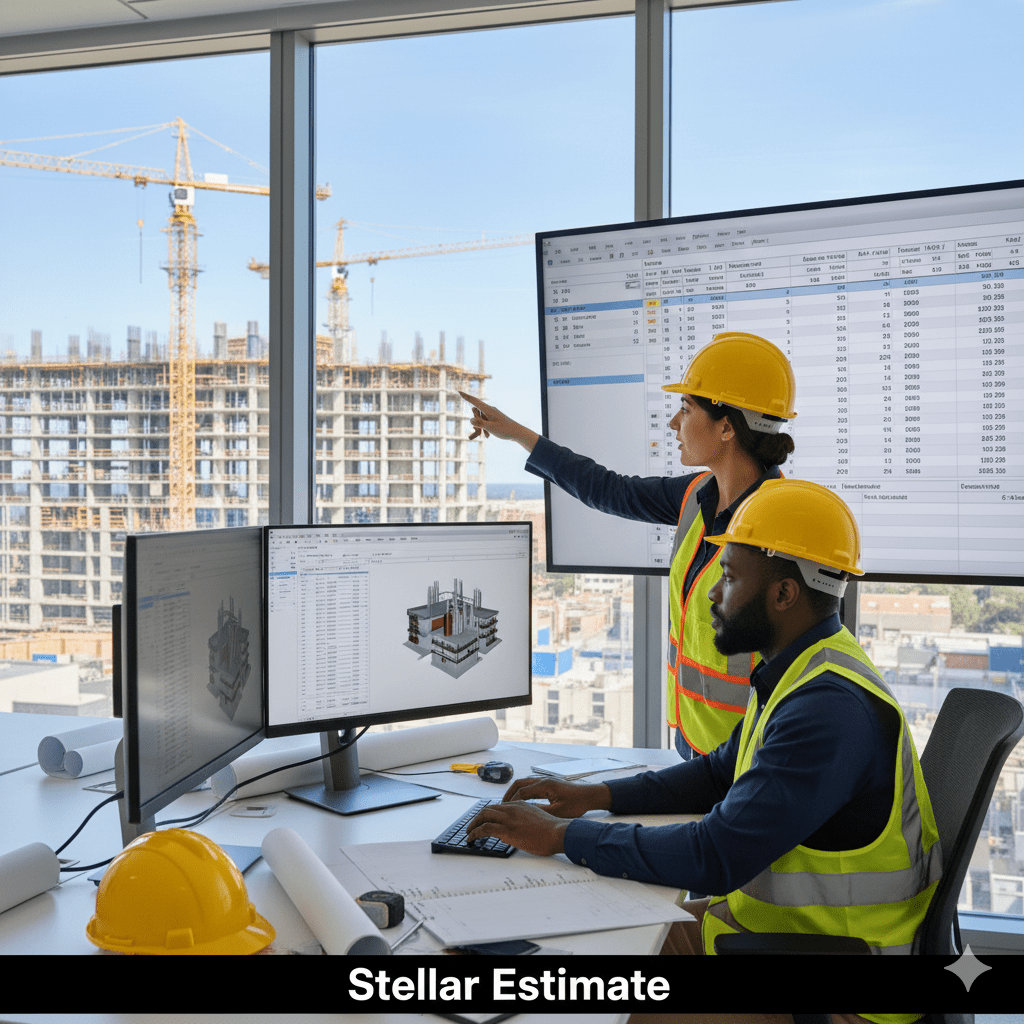
How to Become a Construction Estimator: Step-by-Step Process
Step 1: Obtain the Necessary Education
Generally, the required qualification to become a construction estimator is a high school diploma, but many estimators will choose to pursue additional education to improve their job opportunities. Below are the most commonly pursued forms of education:
- High School Diploma/GED: You will begin taking some introductory classes in math, science, and construction-related topics to lay a foundation to work from.
- Associate’s Degree: Many aspiring estimators will pursue education programs related to construction management, civil engineering, or architecture..
- Bachelor’s Degree: If you have a 4-year degree in construction management, civil engineering, or a related major, then you would be a more attractive candidate for the position.
Step 2: Gain Experience in the Construction Industry
To be an estimator requires that you work in the construction industry. Many estimators have started in entry-level positions in construction, such as construction worker, carpenter, or project assistant, to learn the processes involved in the construction business.
Step 3: Develop Key Skills
To gain success and recognition as a building estimator, there are a handful of essential skills you’ll need to develop. They encompass:
- Mathematical Skills: Estimators need to be able to accurately come up with quantities and costs, factoring in variables such as labor rates and time inherent to the project
- Attention to Detail: Small suggests that even minor mistakes in an estimate can lead to considerable overrunning costs.
- Analytical Thinking: Estimators need to systematically dissect plans and blueprints in order to ascertain the materials and labor for each project.
- Communication Skills: It is important that estimators are able to communicate estimates clearly with contractors, suppliers, and clients in order to achieve clarity and efficiency.
- Computer Proficiency: Estimators often utilize construction-specific software such as Procore or Buildertrend for estimating and budgeting, or use some version of Excel.
Step 4: Gain Professional Certifications
Certifications are not necessary, but they lead to improvements towards that next step in your career. For example, the Association for the Advancement of Cost Engineering has credentials (for example, Certified Estimating Professional [CEP]). The American Society of Professional Estimators (ASPE) offers some certification options to help professional estimators achieve upward mobility.
Step 5: Apply for Jobs as a Construction Estimator
After you have completed your schooling and achieved the minimum requirements for experience, you should prepare to begin searching for construction estimator jobs. Most employers are more inclined to choose someone with relevant experience in a specific type of construction, such as residential, commercial, or industrial experience. Having industry contacts is also helpful since this leads to job placement.
Average Salary and Job Outlook for Construction Estimators
In terms of the combination of salary and job security, construction estimating can be a well-paying job. According to the U.S. Bureau of Labor Statistics (BLS), the following statistics include:
- Median Annual Salary: $64,000 (according to 2023 BLS data).
- Top 10% of Earners: Over $100,000 per year.
- Job Growth: Job Growth: Employment of construction estimators is projected to grow by 11% from 2020-2030, which is faster than the average for all occupations.
Key Mathematical Concepts in Construction Estimating
To guarantee the accuracy of the estimator’s computations, estimators require specific mathematical concepts to calculate those prices. Some of the concepts include:
1. Linear Measurement
Estimators will look to determine the spaces of the project in terms of length, width, and height so that they can quantify their calculations to determine how much material is necessary. The estimator can then use those calculations to determine the volume or area based on the length, width, and height.
Example Calculation:
- Area = Length × Width
- Volume = Length × Width × Height
2. Unit Pricing
Estimators use unit prices to calculate the amount of materials that will be needed in addition to the estimated amount of labor that’s required to complete the project.
Example: If a project requires drywall, and the drywall is required to cover 500 cubic feet and the cost is $2.50 per square foot, the estimated cost for the drywall will be
500 sq. ft × $2.50/sq. ft = $1,250
3. Quantity Takeoff
The quantity take off entails figuring out the total amounts of everything for the project. Similar to linear measurement, the estimator will unassemble the project piece by piece to arrive at a general quantity take off.
Example Calculation:
For a project involving roofing, an estimator may calculate:
- Number of shingles required = Roof Area / Shingle Coverage
- Roof Area = 1200 sq. ft
- Shingle Coverage = 100 sq. ft per bundle
1200 sq. ft ÷ 100 sq. ft = 12 bundles of shingles
4. Markup
To receive a profit, an estimator will markup their cost of calculating the materials and the estimated labor. This calculation typically includes the markup for overhead and profit of the estimator.
Example Calculation:
If the total cost of materials and labor is $10,000 and the desired level of markup is 20%, then the total cost (with markup) would be:
$10,000 × (1 + 0.20) = $12,000

FAQs
1. What qualifications do you need to become a construction estimator?
Construction estimators generally have a degree in construction management or a related field and have work experience in a similar environment.
2. What skills are important for a construction estimator?
Construction estimators should be math proficient, detail-oriented, analytical, good communicators, and preferably be proficient/data-driven in estimating software or programs.
3. How long does it take to become a construction estimator?
Becoming a construction estimator typically requires 4 years for a bachelor’s degree, as well as years of field experience in the construction industry.
4. What is the job outlook for construction estimators?
The job outlook for construction estimators is promising since employment is anticipated to grow 11% from 2020 – 2030.
5. How much do construction estimators make?
The estimated median pay for construction estimators is about $64,000, but it could have the potential to be more based measuring overall experience and specialization in certain industries.
