
How to Calculate Home Construction Cost in Texas: A Comprehensive Guide
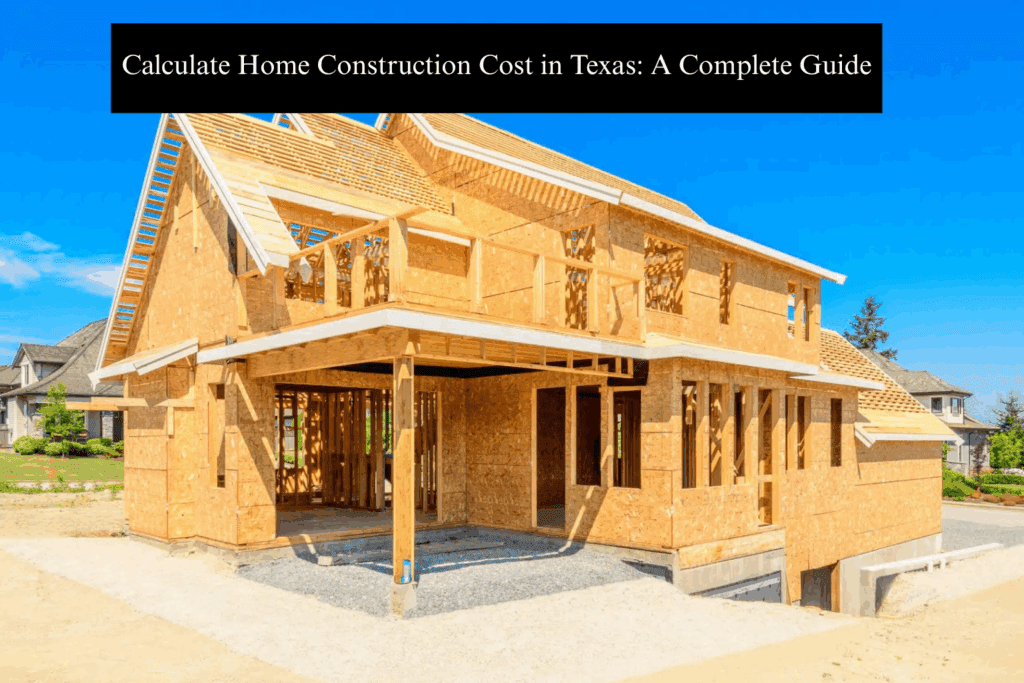
How to Calculate Home Construction Cost in Texas: A Comprehensive Guide Building a home is a monumental decision, both emotionally and financially. Whether you’re building your dream house or a rental property, the cost of construction in Texas can vary widely based on several factors. From the location of your build to the materials and labor you choose, understanding the factors that contribute to your home’s construction cost is essential for budgeting effectively. In this article, we will take an in-depth look at how to calculate home construction costs in Texas, with helpful insights and breakdowns, so you can get an accurate estimate and plan accordingly. Understanding the Key Factors Affecting Home Construction Costs in Texas The first step in calculating home construction costs is understanding the various factors that influence these costs. The state of Texas is large, with a wide range of factors that can impact how much it will cost to build a home in different regions. Let’s take a closer look at the key factors involved. Location in Texas Urban vs. Rural: Building a home in a metropolitan area like Austin, Dallas, Houston, or San Antonio will generally be more expensive than building in rural areas. Urban locations tend to have higher labor costs, more expensive materials, and higher permit fees. The demand for construction in urban areas leads to increased competition for materials and labor, driving up costs. Region-Specific Conditions: Areas with specific conditions such as coastal regions (near the Gulf of Mexico) or flood-prone zones may require additional precautions, like stronger foundations, water-resistant materials, or floodproofing measures, all of which can drive up construction costs. Size of the Home Square Footage: The size of your home is one of the most straightforward factors to consider when estimating the cost of construction. A larger home will, of course, cost more to build, but the cost per square foot can decrease as the size of the home increases. Design Complexity: A larger home with a more complex design (multiple stories, unique architectural features, or custom layouts) will also increase the cost compared to a more basic, straightforward design. Construction Type and Materials Materials: The type of materials you use for the structure, interior, and finishes will significantly impact the overall cost. Basic materials, such as vinyl siding and laminate countertops, are less expensive than custom materials like marble countertops or stone facades. Energy-Efficiency: High-performance insulation, energy-efficient windows, and green building materials can reduce your energy bills in the long term but can increase upfront construction costs. Labor Costs Labor Availability: Labor costs in Texas vary by location and demand. Urban areas with a high demand for skilled workers can have higher labor costs, while rural regions may have more affordable rates but may also have fewer options for contractors. Skill Level: Skilled labor (like electricians, plumbers, and framers) will often cost more due to the expertise required. Similarly, contractors with more experience or specialized skills in custom builds will charge more than general contractors. Permits and Regulations Local Permits: Every area in Texas will have different regulations when it comes to permits and fees. Large cities tend to have more complex permit processes, which can add extra time and costs to your project. Zoning Laws: Make sure that your land is properly zoned for residential construction, as changing zoning laws or regulations can add unforeseen costs or delays. Utilities and Infrastructure Utility Hookups: Connecting your home to local utilities such as water, sewage, and electricity can be an additional cost that varies based on your location. In rural areas, running utility lines to a new home can be expensive. Septic Systems and Well Drilling: In areas where city utilities are not available, you may need a septic system and/or a private well, which can add significant costs. Estimating the Cost Per Square Foot in Texas To provide a clearer understanding of how much it costs to build a house in Texas, let’s look at some average costs per square foot. The cost of construction typically ranges between $100 to $300 per square foot, depending on the factors mentioned earlier. Here’s a breakdown of what you might expect: Home Type Cost Per Square Foot Estimated Total for a 2,500 sq. ft. Home Basic Construction $100 – $150 $250,000 – $375,000 Mid-Range Construction $150 – $200 $375,000 – $500,000 High-End Construction $200 – $300+ $500,000 – $750,000+ Basic Construction: This price range typically includes standard building materials like vinyl siding, standard roofing, and basic finishes inside the house. It may also include a simple floor plan with fewer architectural details. Mid-Range Construction: This range allows for higher-quality materials, such as brick or stone exteriors, upgraded interior finishes like granite countertops, and additional custom features in the home’s layout. High-End Construction: For those looking for luxury builds, this price range includes premium materials, custom design work, high-end appliances, energy-efficient systems, and high-level finishes throughout the home. How to Calculate Your Construction Costs in Texas: Step-by-Step Process Now that we have a clearer idea of the factors involved in home construction costs, let’s break down the process into actionable steps to estimate the total cost of your project. Step 1: Determine the Square Footage of Your Home The first step in any construction project is determining the square footage of the home you plan to build. Measure the dimensions of each floor of the home and calculate the total area. You can then multiply that by the estimated cost per square foot to get an overall cost range. Step 2: Choose Your Materials and Design Once you know your square footage, decide on the materials and design elements you want. A modern design with eco-friendly materials will cost more, while a more standard design with basic materials may fall on the lower end of the cost spectrum. Step 3: Account for Additional Costs Remember to factor in additional expenses such as: Site Preparation: Clearing the land, leveling the
How to Calculate Home Construction Cost in Utah: A Step-by-Step Guide
How to Calculate Home Construction Cost in Utah: A Step-by-Step Guide Constructing a house is a significant financial move, and it is important to know how to estimate the cost of construction so that you can control your budget. In building a house in Utah, a number of issues are put into consideration which include the place of construction, size, construction materials and work force that will be involved in the construction which will affect the overall cost. Here, we will take you through the process of determining the cost of constructions in your home, using real data, and subdividing it into a more manageable part. At the end of the article you will have a clear picture on how much it can cost to construct a home in the state of Utah and you can copy the data in Excel sheet so you can then use your own calculations. Factors Affecting Home Construction Cost in Utah Before we dive into the cost breakdown, it’s important to understand the factors that influence home construction costs: Step-by-Step Process to Calculate Home Construction Cost in Utah Now that we understand the influencing factors, let’s go step-by-step in calculating the cost of building a home in Utah. For this example, we’ll use a 2,500 sq. ft. home with mid-range finishes. Determine the Square Footage The cost of building a home is often calculated on a per-square-foot basis. In Utah, construction costs typically range from $150 to $250 per square foot depending on the location and the quality of materials. Home Type Cost per Square Foot (Approx.) Standard Home $150 – $200 Mid-range Home $200 – $250 Luxury Home $250+ For this example, let’s assume the cost per square foot is $225, as we are building a mid-range home. Base Construction Cost Calculation: Base Construction Cost=2,500 sq. ft.×225 USD/sq. ft.=562,500 USDtext{Base Construction Cost} = 2,500 , text{sq. ft.} times 225 , text{USD/sq. ft.} = 562,500 , text{USD}Base Construction Cost=2,500sq. ft.×225USD/sq. ft.=562,500USD Include Site Preparation and Utility Installation Site preparation and utility installation are necessary for many construction projects, especially if the land needs to be cleared or graded. Cost Type Estimated Cost Site Preparation $5,000 – $30,000 Utility Installation $3,000 – $10,000 For this example, let’s assume $20,000 for site preparation and utility installation. Updated Total After Site Preparation: Total After Site Prep=562,500 USD+20,000 USD=582,500 USDtext{Total After Site Prep} = 562,500 , text{USD} + 20,000 , text{USD} = 582,500 , text{USD}Total After Site Prep=562,500USD+20,000USD=582,500USD Add Permits and Fees Permits and fees are required for building in Utah. These typically range from $1,000 to $5,000, depending on the project’s size and location. Permit Type Estimated Cost Building Permit $1,000 – $3,000 Inspection Fees $500 – $2,000 For this example, we’ll assume $3,000 in permits and fees. Updated Total After Permits: Total After Permits=582,500 USD+3,000 USD=585,500 USDtext{Total After Permits} = 582,500 , text{USD} + 3,000 , text{USD} = 585,500 , text{USD}Total After Permits=582,500USD+3,000USD=585,500USD Add Landscaping and Additional Features Landscaping and additional features like fencing, driveways, or outdoor structures can add significant costs. Feature Type Estimated Cost Landscaping $5,000 – $20,000 Additional Features (Driveways, Fencing) $2,000 – $10,000 Let’s assume $10,000 for landscaping and additional features. Updated Total After Landscaping: Total After Landscaping=585,500 USD+10,000 USD=595,500 USDtext{Total After Landscaping} = 585,500 , text{USD} + 10,000 , text{USD} = 595,500 , text{USD}Total After Landscaping=585,500USD+10,000USD=595,500USD Add Insurance and Interior Finishes Construction insurance protects against unexpected liabilities, and interior finishes (flooring, cabinetry, etc.) can vary based on your choices. Cost Type Estimated Cost Insurance $1,000 – $3,000 Interior Finishes (Cabinetry, Flooring, etc.) $10,000 – $50,000 Let’s assume $2,000 for insurance and $50,000 for interior finishes. Updated Total After Insurance & Finishes: Total After Insurance and Finishes=595,500 USD+2,000 USD+50,000 USD=647,500 USDtext{Total After Insurance and Finishes} = 595,500 , text{USD} + 2,000 , text{USD} + 50,000 , text{USD} = 647,500 , text{USD}Total After Insurance and Finishes=595,500USD+2,000USD+50,000USD=647,500USD Final Cost Breakdown Here’s a summary of the total construction cost based on the example provided. Cost Category Estimated Cost (USD) Base Construction (2,500 sq. ft. @ $225/sq. ft.) 562,500 Site Preparation & Utilities 20,000 Permits & Fees 3,000 Landscaping & Additional Features 10,000 Insurance 2,000 Interior Finishes 50,000 Total Estimated Cost 647,500 Final Thoughts Constructing a house in Utah is a process that has a number of expenses that you have to factor in to keep within your budget. The price of construction may be significantly different, depending on the place, size, and your decisions concerning the materials and features, as we have proven. The average estimated price of a 2,500 sq. ft. middle range house in Utah is 647,500. But each project is different, so these figures will have to be changed in accordance with your own situation. Conclusion You can use the data above and the findings on the elements that affect Home Construction Cost in Utah to better estimate your home-building budget. It is always advisable to negotiate with local contractors and specialists so that you can receive more precise quotation depending on your project requirements. Also make sure that you consider the hidden expenses and have a contingency budget to prevent financial shocks. Having the information in this article, you are now equipped to plan and budget the cost of building a home in Utah effectively! Steps to Get Started 1. Upload Plans Send us your project drawings, specifications, and scope of work via email. Our team will review the plans and provide you with a customized quote for our drywall estimating service, including pricing and turnaround time. 2. Pay Invoice Upon approval of the quote, we’ll send you an invoice that can be conveniently paid online using any major credit card. Once payment is confirmed, our drywall estimators will immediately begin working on your project. 3. Receive Estimate Within the agreed turnaround time, you’ll receive the estimate, along with PDF colored marked plans, via email. The estimate will be provided in an Excel spreadsheet format, containing all the drywall quantities and pricing based on the agreed scope of work. Upload Plans Save 50% On 3 Projects Contact Us Let’s Get in Touch Email Address Info@stellarestimate.com Call Us +1 (201) 210-5306 Address 11952 Mt Vernon Ave, Grand Terrace CA 92313 Send Message Facebook Twitter Instagram Flickr 500px
Calculate Home Construction Cost in California: A Comprehensive Guide

Calculate Home Construction Cost in California: A Comprehensive Guide Building a house in California is a significant investment, with costs influenced by numerous factors from location to material choices. Whether you’re planning a basic builder-grade home or a luxury custom design, understanding how to calculate home construction costs is crucial for budgeting and planning. This guide will walk you through the average costs, factors that impact pricing, and tips to manage your construction budget effectively. Average Cost to Build a House in California The cost to build a house in California typically ranges from $360,000 to $1,500,000, excluding land and site preparation. Here’s a breakdown: Basic builder-grade homes: $200 to $400 per square foot Custom homes: $400 to $600 per square foot These figures are averages and can vary based on several variables, such as location, size, and finish levels. Cost Per Square Foot Home Size (sq ft) Basic Builder-Grade Home Custom Home 800 $160,000 – $320,000 $320,000 – $480,000 1,000 $200,000 – $400,000 $400,000 – $600,000 1,500 $300,000 – $600,000 $600,000 – $900,000 1,800 $360,000 – $720,000 $720,000 – $1,080,000 2,000 $400,000 – $800,000 $800,000 – $1,200,000 2,500 $500,000 – $1,000,000 $1,000,000 – $1,500,000 3,000 $600,000 – $1,200,000 $1,200,000 – $1,800,000 3,500 $700,000 – $1,400,000 $1,400,000 – $2,100,000 4,000 $800,000 – $1,600,000 $1,600,000 – $2,400,000 Note: These costs exclude the price of land and site preparation. Unlock Exclusive Savings on Your Next Project! Save 50% on Our Estimating Services for Your First 3 Projects! Get Started Now Offer valid on first 3 projects submitted. Terms apply. Steps to Get Started Uplaod Plans How to Reduce Home Construction Costs in California Building a home in California is a major investment, but with careful planning, you can manage expenses without compromising quality. Here are several proven strategies to reduce costs: Optimize Your Home Design Simpler floor plans: Homes with rectangular layouts and fewer corners are easier and cheaper to build than complex or irregular designs. Single-story vs. multi-story: Multi-story homes require more structural work, stairs, and labor. If possible, a well-designed single-story home can reduce costs. Open floor plans: Open layouts reduce the number of interior walls, framing, and materials, potentially saving thousands. Smart Material Selection Cost-effective alternatives: For countertops, flooring, and cabinets, materials like laminate, engineered wood, or recycled composites can mimic high-end finishes at a lower cost. Bulk purchases: Buying materials in bulk or sourcing from wholesale suppliers can provide significant savings. Energy-efficient materials: High-quality insulation, low-E windows, and energy-efficient doors may have higher upfront costs but reduce long-term energy bills. Timing and Scheduling Off-peak construction: Labor and material costs can fluctuate seasonally. Starting your project during slower months may reduce expenses. Avoid delays: Weather, inspections, and permitting delays increase labor costs. A realistic schedule with contingency planning can minimize overruns. Modular or Prefabricated Homes Faster construction: Modular or prefab components are built off-site and assembled on-site, reducing labor costs and construction time. Consistent quality: Factory-controlled environments can reduce errors and material waste. Sustainability: Prefabricated homes often generate less construction debris, aligning with California’s eco-friendly regulations. Energy Efficiency and Green Building Long-term savings: Solar panels, energy-efficient HVAC systems, and high-performance windows reduce utility bills over time. Rebates and incentives: California offers tax credits and rebates for energy-efficient upgrades, which can offset initial costs. Eco-friendly landscaping: Drought-tolerant plants and water-saving irrigation systems reduce maintenance and utility costs. Labor Management Hire experienced contractors: Skilled builders may charge more but reduce mistakes and delays, which often save money in the long run. Negotiate labor rates: Get multiple quotes and ask for itemized pricing. Skilled trades sometimes offer discounts for extended projects or bundled work. DIY selectively: If you have expertise, handling minor tasks like painting or landscaping yourself can reduce costs. Reuse, Recycle, and Salvage Reclaimed materials: Cabinets, doors, flooring, and even bricks can be sourced from reclaimed suppliers for lower prices. Repurpose materials: Items from previous projects, like fixtures or lumber, can be repurposed. Sustainable options: Using recycled materials reduces waste and aligns with California’s green building codes. Emerging Trends Impacting Construction Costs in California Staying informed about trends helps you anticipate potential cost changes: Labor shortages: Skilled labor is in high demand. Hiring experienced local contractors can prevent delays and additional costs. Material price fluctuations: Lumber, steel, and concrete prices are volatile. Locking in contracts early or ordering materials in advance can prevent unexpected price hikes. Environmental regulations: California’s strict building codes may require energy-efficient and sustainable design elements, increasing upfront costs but providing long-term savings. Smart home integration: Automation systems, smart thermostats, and home security increase construction costs if not planned early. Integrating them during the build is more cost-effective than retrofitting later. Calculate Home Construction Cost: Key Factors Location: Coastal and urban areas in California have higher labor and material costs. For example, building in Los Angeles or San Francisco will be more expensive than in rural areas. Home Size and Layout: Larger homes and those with complex designs or multiple stories are more expensive to build. Material Quality and Finishes: Choices such as granite countertops, hardwood floors, and high-end fixtures can significantly increase costs. Foundation and Site Preparation: Costs can escalate if the building site requires extensive leveling, excavation, or if it’s located on a slope. Labor Costs: The cost of skilled labor varies, with more complex projects requiring specialized contractors who charge higher rates. Detailed Breakdown of Construction Costs Category Average Cost* Foundation $9,000 – $28,000 Framing $22,000 – $60,000 Roof $6,000 – $18,000 Siding $8,000 – $26,000 Electrical $8,000 – $18,000 Solar Panels $12,500 – $17,300 Plumbing $8,000 – $12,000 HVAC $7,000 – $16,000 Interior Finishes & Fixtures $50,000 – $200,000+ Appliances $3,100 – $7,700 Building Permits $1,500 – $5,000 Including labor and materials Land and Site Preparation Land Cost: Depending on the location, land in California can range from $6,000 to $14,000 per acre, with urban and coastal plots costing significantly more. Land Survey: Costs between $400 and $1,800 to delineate property boundaries. Site Prep: Site leveling and excavation range
